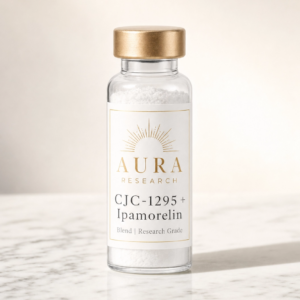

Most mistakes in peptide purchasing happen before anything reaches the bench. They happen when a buyer confuses marketing language with evidence, accepts vague purity claims, or treats all suppliers as interchangeable. If you want to understand how to research peptides properly, start there: not with promises, but with documentation, study quality, and whether a supplier is willing to show its working.
Peptides sit in a category where interest often moves faster than evidence. Some compounds are backed by substantial preclinical literature and clearly defined mechanisms worth investigating. Others are surrounded by recycled claims, poor sourcing standards, and product pages that tell you almost nothing of scientific value. Serious research starts by separating those two worlds.
How to research peptides without relying on hype
The first job is to define what question you are actually trying to answer. “Which peptide should I buy?” is not a research question. “Which compounds are being studied for senescence signalling?” or “What evidence exists around a specific peptide in dermal biology models?” is a research question. That distinction matters because it changes what you look for.
When the objective is vague, buyers drift towards trend-driven compounds and broad claims. When the objective is specific, you can evaluate relevance, evidence strength, and sourcing quality with far more discipline. In practice, that means identifying the research area first – regenerative biology, neuropeptides, bioenergetics, skin biology, or another defined domain – and then narrowing to compounds with a plausible mechanistic fit.
A peptide should not be interesting simply because people are talking about it. It should be interesting because there is enough credible material to justify further investigation.
Start with the evidence, not the catalogue
Before you compare suppliers, assess the underlying research landscape. Look at the type of evidence available for the peptide in question. Is the literature largely in vitro, animal-based, early-stage exploratory, or something more developed? Are the proposed effects consistent across studies, or do they vary significantly by model, dose, or endpoint?
This is where nuance matters. A peptide can be promising and still be poorly characterised. It can have a compelling mechanism on paper and still lack meaningful replication. It can also be heavily discussed online while having very little serious literature behind it. None of those realities automatically invalidate a compound, but they should affect how confidently you interpret it.
Good peptide research means reading past the headline finding. Study population, model design, route of administration, stability, and assay endpoints all matter. A result observed under narrow conditions may not support the sweeping language often used in low-trust marketing.
If the evidence base is thin, say so. If findings are mixed, treat them as mixed. Serious researchers are not looking for certainty where none exists.
Read the documents that sellers hope you ignore
Once a peptide is worth investigating, the next question is whether the material being sold is fit for research use. This is where many suppliers fail. They rely on clean branding and generic claims instead of batch-level proof.
At minimum, you should expect a current Certificate of Analysis for the exact batch, not a template and not a blurred screenshot. The COA should show batch identification, analytical method, and purity result. If a seller claims HPLC verification, that should be visible in the documentation rather than mentioned as a slogan.
Purity is not the only consideration, but it is a foundational one. A stated purity threshold means little if there is no accessible evidence behind it. Third-party testing adds another layer of confidence because it reduces the risk of a supplier simply marking their own homework.
If a supplier will not show public batch documentation without forcing an email capture or evasive back-and-forth, that is useful information. In a category this sensitive, transparency is not a premium extra. It is the minimum standard.
What a COA can tell you – and what it cannot
A COA can confirm that a batch was tested and met certain analytical criteria. It can support claims around identity or purity, depending on the methods used. It cannot tell you whether broad claims made around the peptide are scientifically justified, and it cannot replace a proper review of the literature.
That distinction is worth holding firmly. Documentation validates the material. It does not validate exaggerated interpretation.
Assess supplier quality like a researcher, not a casual shopper
Peptide sourcing should be approached as a quality systems question. Ask what the supplier can prove consistently, not what they can say persuasively.
Look for batch-level transparency, clearly stated purity standards, third-party testing, and explicit research-use-only compliance language. A serious supplier should also be clear about storage guidance, handling expectations, and what is and is not being claimed. Ambiguity is rarely accidental in this category.
You should also pay attention to how products are organised. Suppliers that group compounds into coherent research areas or protocol frameworks often make it easier to evaluate relevance and compare related options. That said, curation only helps if it is paired with evidence-led education. A neat category page means very little without analytical records and honest scientific framing.
This is one reason education ecosystems matter. A supplier that publishes interpretive content on compound classes, mechanisms, and documentation standards is generally easier to vet than one that just lists stock and waits for checkout. Aura Research, for example, has built much of its model around that principle: batch-level transparency first, then education that helps researchers interpret what they are looking at.
How to research peptides by comparing claims against proof
The fastest way to spot weak suppliers is to compare what they claim with what they actually provide. If a product page uses definitive language but offers no supporting analytical data, that gap matters. If purity is highlighted but no batch-specific result is visible, that gap matters. If the copy sounds confident while remaining technically vague, that gap matters too.
High-trust suppliers tend to be precise. They tell you what the compound is, how it has been studied, what documentation is available, and where the evidential limits are. Low-trust suppliers tend to overstate certainty, underdeliver on records, and rely on buyers not asking difficult questions.
This is not just about avoiding poor purchasing decisions. It is about protecting the integrity of your own research process. Weak inputs create weak conclusions.
Practical checks before you buy
A few standards are non-negotiable. Confirm that the batch has accessible documentation. Confirm that the testing method is named. Confirm that purity figures are specific rather than vague. Confirm that the supplier uses clear research-use-only boundaries. Then check whether their educational material reflects actual scientific caution or merely imitates it.
If a seller cannot meet those standards, move on.
Understand where the real trade-offs are
Not every decision comes down to picking the highest stated purity and stopping there. Real trade-offs exist.
A highly discussed peptide may have less mature evidence than a less fashionable one. A supplier with broad catalogue volume may offer weaker transparency than a more selective supplier focused on verified compounds. A lower price can reflect efficiency, but in this category it can also reflect weaker testing, looser standards, or both.
There is also a difference between a peptide being suitable for your research question and being popular in the wider market. Those are not the same thing. Researchers who stay disciplined tend to get better results because they resist the pressure to chase whatever is currently circulating in forums and promotional copy.
The right approach is usually narrower and more methodical than people expect. Define the model. Review the evidence. Verify the batch documentation. Assess the supplier. Then decide whether the compound genuinely fits the research objective.
A better standard for peptide research
If you strip the process back, knowing how to research peptides comes down to one principle: every claim should face evidence, and every product should face documentation. That standard immediately filters out most of the noise.
You do not need a supplier with the loudest branding. You need one that will show purity data, third-party verification, and batch-specific records without hesitation. You do not need educational content that promises certainty. You need material that helps you understand what is known, what is still uncertain, and what should be treated cautiously.
In a market crowded with recycled claims and thin documentation, the serious advantage is not speed. It is discipline. Ask better questions, expect better records, and treat transparency as the baseline rather than the bonus. That is where sound peptide research begins.